
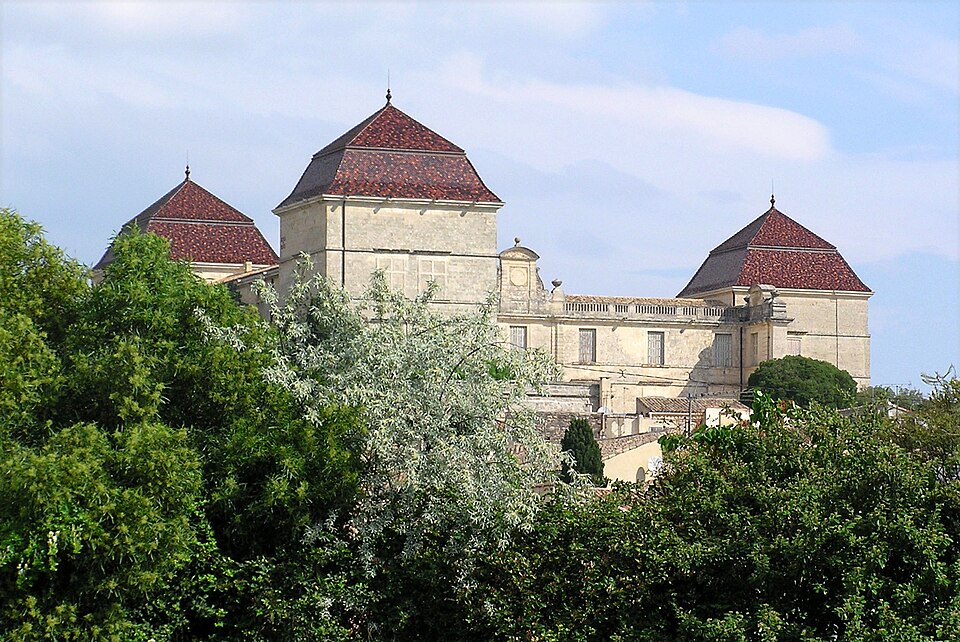
Castries
Château de Castries
Duc, historien, académicien ; racheta le château en 1935 et le donna à l'Académie française en 1985
→Duc de Castries (courtesy title) · Member of the Académie française (fauteuil 2)
René de La Croix de Castries (château de la Bastide-d'Engras, near Uzès, 6 août 1908 – 17 juillet 1986), known as the “Duc de Castries”, was a historian and novelist and a member of the Académie française. From the junior branch of the La Croix de Castries family, he grew up at the château de Gaujac (Gard) and initially intended for a career in diplomacy. In 1935 he bought back the family château de Castries, which the family had owned from 1495 but which had passed to the Harcourt family. He restored it, farmed its vineyards and patiently gathered portraits, furniture and relics of his lineage, turning the site into a true conservatory of his family's history. Mayor of Castries from 1941 to 1950, he then settled in Paris and became one of the most widely read biographers of his day, specialising in the period 1750–1850: Mirabeau, Madame du Barry, Louis XVIII, La Fayette, Chateaubriand, Louis-Philippe… Elected to the Académie française on 4 mai 1972 to fauteuil 2, he presided over the Institut de France in 1982. In 1985 he gave the château and its collections to the Académie française; he died the following year.
When René de Castries bought back the château in 1935, the residence had suffered looting during the Revolution and several changes of ownership. He set about restoring it, refurnishing its reception rooms and gathering the family's scattered works. DRAC Occitanie stresses that the ensemble formed by the architecture and the furnishings is the result of this determination: the duke wanted to make the château a conservatory of the history of the Castries family. Today, 305 objects from the château are protected as historic monuments.
Château de CastriesBorn at the château de la Bastide-d'Engras; childhood at the château de Gaujac and in Nîmes.
Graduated in public finance from Sciences Po.
Marries Monique de Casagne.
Buys back the château de Castries, which he restores and whose vineyards he farms.
Mayor of Castries, notably during the Occupation and the Liberation.
First novel, Mademoiselle de Méthamis (Prix Balzac).
Le Maréchal de Castries, a biography of his ancestor, awarded the Prix Eugène Carrière by the Académie française.
Publishes Le Château de Castries.
Elected to the Académie française to fauteuil 2; received on 1er février 1973 by Jacques Chastenet.
President of the Institut de France.
Donation of the château de Castries to the Académie française.
Dies.
From 1955 onwards, he published almost one book a year, alternating syntheses and biographies: Le Testament de la monarchie (5 volumes), Mirabeau, Madame du Barry, Louis XVIII, La Fayette, Chateaubriand, Louis-Philippe, Monsieur Thiers. He is vice-president of the Société des gens de lettres (1964) and chairs the Société de l'histoire de France (1974).
In 1985 the duke gave the château and its collections to the Académie française. This donation, which was contested, led in 2013 to the sale of the estate to the commune of Castries, which carried out the restoration work and reopened the château to the public in 2026.
Cette synthèse croise plusieurs sources pour documenter les lieux, événements et relations historiques.