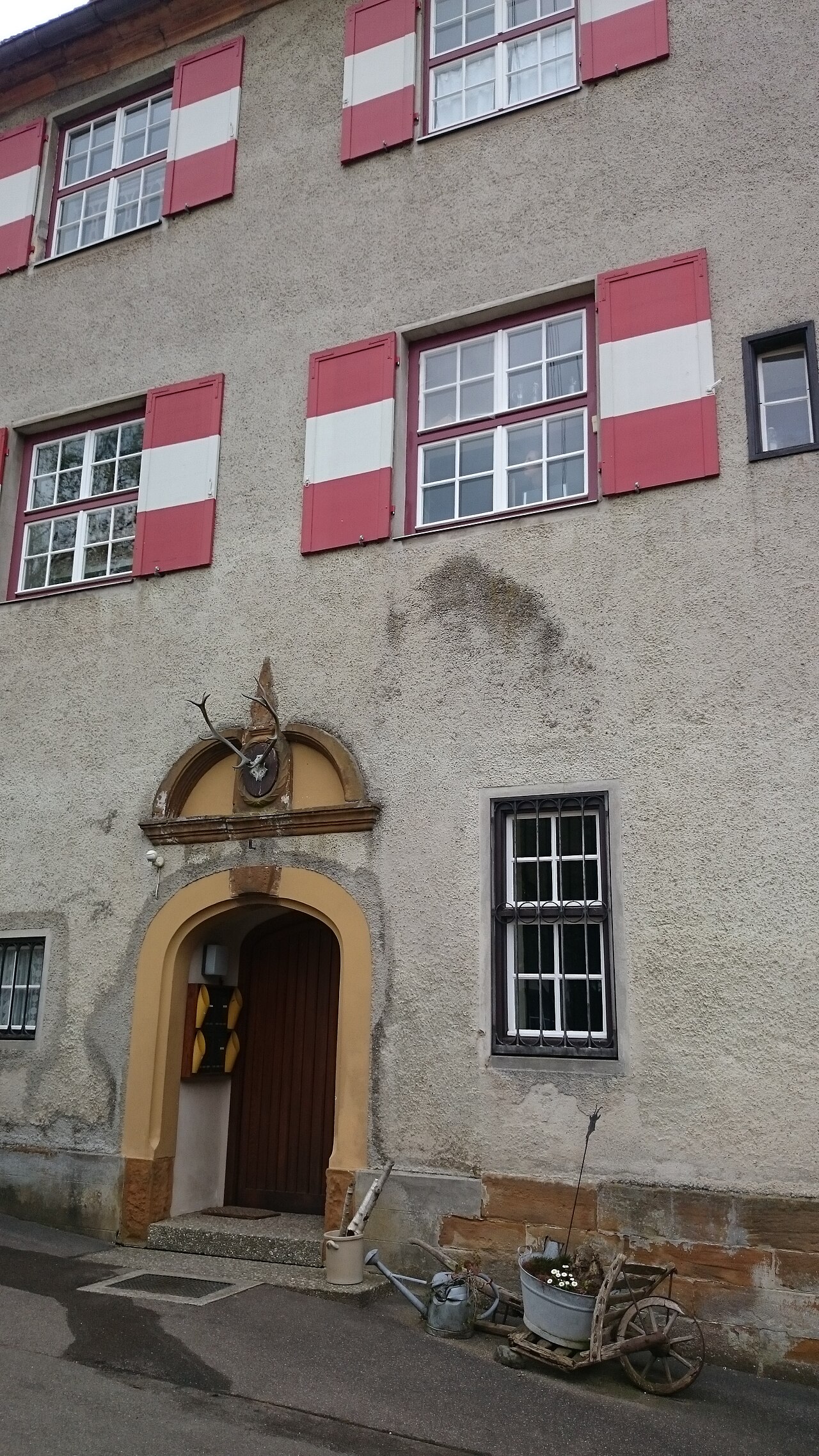
Château Renaissance de trois niveaux vers 1610
Winzingen Castle (Schloß Winzingen)
Architecture, patrimoine et histoire · Landkreis Göppingen
In the village of Winzingen, part of the municipality of Donzdorf at the foot of the Swabian Jura, the castle occupies the site of a medieval noble seat whose family of the same name died out in 1369. The estate then passed successively to the lords of Ahelfingen, of Degenfeld and of Rechberg zu Staufeneck, and in 1599 to the lords of Neuhausen. Around 1610 the old fortified residence was razed and replaced by a rectangular three-storey masonry building in the Renaissance style. Joachim Berchtold von Roth held it in 1607, before Benjamin von Bubenhofen bought it in 1621 from Philipp von Neuhausen. Alterations carried out in 1743–1744 by the architect David Madel of Unterelchingen left three stucco ceilings on the first floor, the staircase and the roof structure, while the Bubenhofen coat of arms still adorns the garden gate. Since 1824 the castle has belonged to the Counts of Rechberg und Rothenlöwen; it is a private residence and is not open to visitors.
⌖
Donzdorf (Winzingen)Landkreis Göppingen
♜
Chronologie documentéePériode de construction
Pourquoi visiter Winzingen Castle (Schloß Winzingen) ?
Plafonds en stuc de 1743-1744
Armoiries des Bubenhofen sur le portail du jardin
L’histoire de Winzingen Castle (Schloß Winzingen)
Siège noble médiéval dont la famille locale s'éteint en 1369, Winzingen passe aux Ahelfingen, Degenfeld, Rechberg puis Neuhausen (1599). Vers 1610 un château Renaissance remplace la burg ; Benjamin von Bubenhofen l'acquiert en 1621. Transformé en 1743-1744, il appartient depuis 1824 aux comtes de Rechberg und Rothenlöwen.
Figures historiques
Personnalités liées à Winzingen Castle (Schloß Winzingen)
Découvrez les femmes et les hommes documentés dans l’histoire de ce château et retrouvez, pour chacun, les autres demeures auxquelles ils sont associés.
Ce qu’il faut observer
Corps de logis rectangulaire de trois niveaux de style Renaissance (vers 1610), remanié en 1743-1744 : plafonds en stuc, escalier et charpente conservés, armoiries des Bubenhofen sur le portail du jardin.
Les étapes de construction
Les principales campagnes documentées qui ont façonné le monument au fil des siècles.
- Datation probable1610Évolution
- Source solide1743–1744Évolution
Nearby
View all castles →