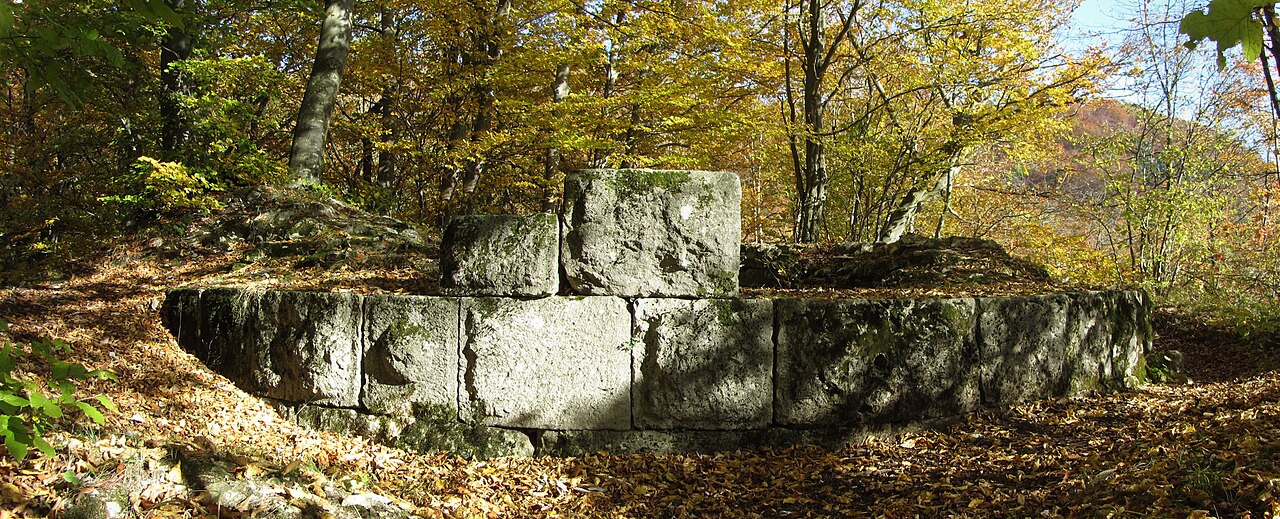
Château classique de 1828 avec belvédère de 1839
Fachsenfeld Palace (Schloß Fachsenfeld)
Architecture, patrimoine et histoire · Ostalbkreis
Fachsenfeld Palace overlooks the Kocher valley in the district of Fachsenfeld, part of the town of Aalen in the Ostalbkreis. From the early 15th century, the barons of Woellwarth-Laubach were lords here. In 1540, Georg Sigmund von Woellwarth had a large farm building erected, which his son Hans Sigmund converted into a palace. During the Thirty Years' War, in 1634, Kaspar von Woellwarth lost the estate to the Teutonic Grand Master Johann Kaspar von Stadion, then recovered it. The palace burned down at Christmas 1699. In the early 19th century the estate passed to Karl von Varnbüler, who sold it in 1827 to Wilhelm von König-Warthausen. From 1828 he built the present classical country house, completed in 1839 by a belvedere, and the Koenig-Fachsenfeld family laid out the landscape park. Around 1900, André Lambert enlarged the library and the gallery. In 1982, Baron Reinhard von Koenig-Fachsenfeld created the foundation that preserves the palace, the park and its collections. Open from April to November, it hosts weddings, concerts and exhibitions.
⌖
AalenOstalbkreis
♜
Chronologie documentéePériode de construction
Préparer votre visite
Toutes les informations pour organiser votre venue au Fachsenfeld Palace (Schloß Fachsenfeld).
Pourquoi visiter Fachsenfeld Palace (Schloß Fachsenfeld) ?
Parc paysager surplombant la vallée du Kocher
Collections de la fondation Koenig-Fachsenfeld
L’histoire de Fachsenfeld Palace (Schloß Fachsenfeld)
Seigneurie des Woellwarth dès le XVe siècle, Fachsenfeld reçoit en 1540 un grand bâtiment transformé en château par Hans Sigmund de Woellwarth. Perdu en 1634 au profit de Johann Kaspar von Stadion puis récupéré, il brûle en 1699. Acquis en 1827 par Wilhelm von König-Warthausen, il est reconstruit en 1828 en style classique ; en 1982, Reinhard von Koenig-Fachsenfeld crée la fondation qui le gère.
Figures historiques Georg Sigmund von Woellwarthbâtisseur du premier édifice1540
 Hans Sigmund von Woellwarthtransforme le bâtiment en châteauXVIe siècle
 Johann Kaspar von Stadiongrand maître de l'ordre Teutonique, détenteur du château1634-1638
 Karl von Varnbülerpropriétairedébut XIXe siècle-1827
 Wilhelm von König-Warthausenacquéreur et bâtisseur du château actuel1827-1828
 André Lambertarchitecte des agrandissementsvers 1900
 Reinhard von Koenig-Fachsenfeldingénieur, fondateur de la fondation1982
Personnalités liées à Fachsenfeld Palace (Schloß Fachsenfeld)
Découvrez les femmes et les hommes documentés dans l’histoire de ce château et retrouvez, pour chacun, les autres demeures auxquelles ils sont associés.
Ce qu’il faut observer
Maison de campagne néoclassique de 1828, dotée d'un belvédère en 1839, dont la bibliothèque et la galerie ont été agrandies vers 1900 par André Lambert. Elle est entourée d'un parc paysager du XIXe siècle descendant vers la vallée du Kocher.
Les étapes de construction
Les principales campagnes documentées qui ont façonné le monument au fil des siècles.
- Source solide1540Évolution
- Source solide1828Évolution
- Source solide1839Évolution
- Datation probable1900Évolution
Nearby
View all castles →