
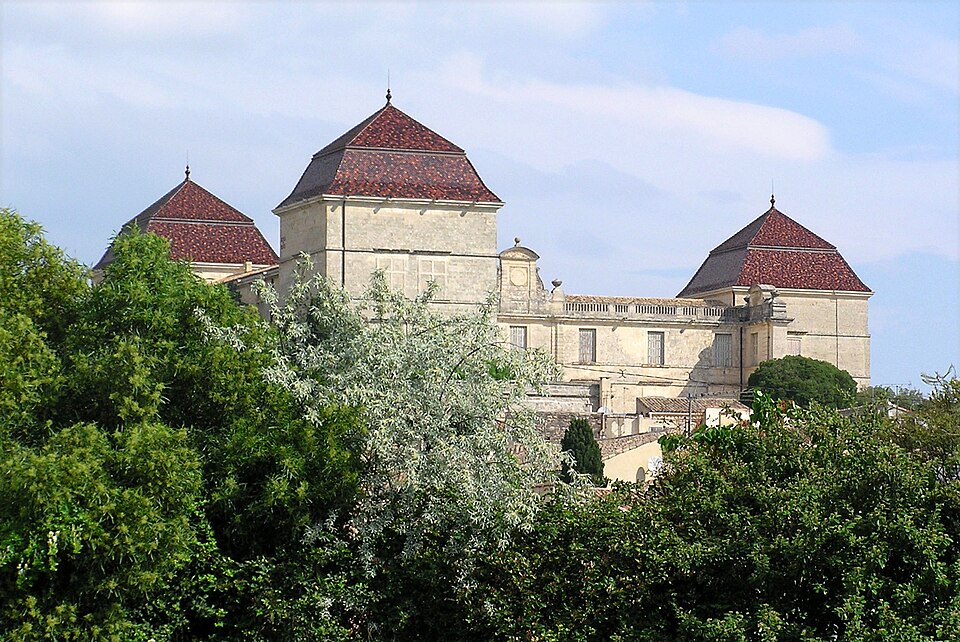
Castries
Château de Castries
Maréchal de France, ministre de la Marine de Louis XVI
→Marquis de Castries · Marshal of France (1783) · Secretary of State for the Navy (1780–1787) · Baron of the Estates of Languedoc · Count of Charlus
Charles Eugène Gabriel de La Croix, marquis de Castries (Paris, 25 February 1727 – Wolfenbüttel, 11 January 1801), is the most illustrious figure of the family that owned the château de Castries. Son of Joseph-François de La Croix de Castries, governor of Montpellier, and Marie-Françoise de Lévis-Charlus, he enjoyed a distinguished military career during the Seven Years' War and distinguished himself at the victory of Clostercamp in 1760, a battle in which the Chevalier d'Assas fell. Summoned by Louis XVI to the secretariat of state for the Navy in 1780, he reorganised the fleet that contributed to the Franco-American victory at Yorktown (1781); he was made Marshal of France in 1783. He left the ministry in 1787 and emigrated in 1789, becoming military adviser to the Count of Provence, future Louis XVIII. He died in exile. The capital of the island of Sainte-Lucie, Castries, bears his name. At the family château, the Estates Room (salle des États) preserves the terracotta bas-relief The Death of the Chevalier d'Assas (1776), a memento of Clostercamp; his descendant René de Castries devoted a biography to him in 1956.
The victory of Clostercamp (1760) is the marquis's principal military achievement. It remains associated with the sacrifice of the Chevalier d'Assas, an officer who is said to have raised the alarm at the cost of his life. The château de Castries preserves, in the Estates Room, the terracotta model of a bas-relief commemorating this death, dated 1776 and the work of the sculptor Antoine; it is classified as a historic monument.
Château de CastriesBorn in Paris, son of the marquis Joseph-François de Castries and Marie-Françoise de Lévis-Charlus.
Joins the Roi-Infanterie regiment.
Victory of Clostercamp (Seven Years' War), marked by the death of the Chevalier d'Assas.
Appointed Secretary of State for the Navy by Louis XVI.
The fleet he had reorganised contributes to the victory at Yorktown.
Raised to the dignity of Marshal of France.
Leaves the Ministry of the Navy.
Emigrates; becomes military adviser to the Count of Provence.
Dies in exile at Wolfenbüttel.
From 1780 to 1787, Castries directed the Navy during the American War of Independence. He modernised the organisation of the fleet and supported the naval operations that weighed on the outcome at Yorktown. His resignation followed the dismissal of Necker, with whom he was close.
The Duke René de Castries, who bought back the château in 1935, devoted a biography to his ancestor in 1956, which was crowned by the Académie française. The current visitor route through the château recounts the history of this lineage in the service of the monarchy.
Cette synthèse croise plusieurs sources pour documenter les lieux, événements et relations historiques.