
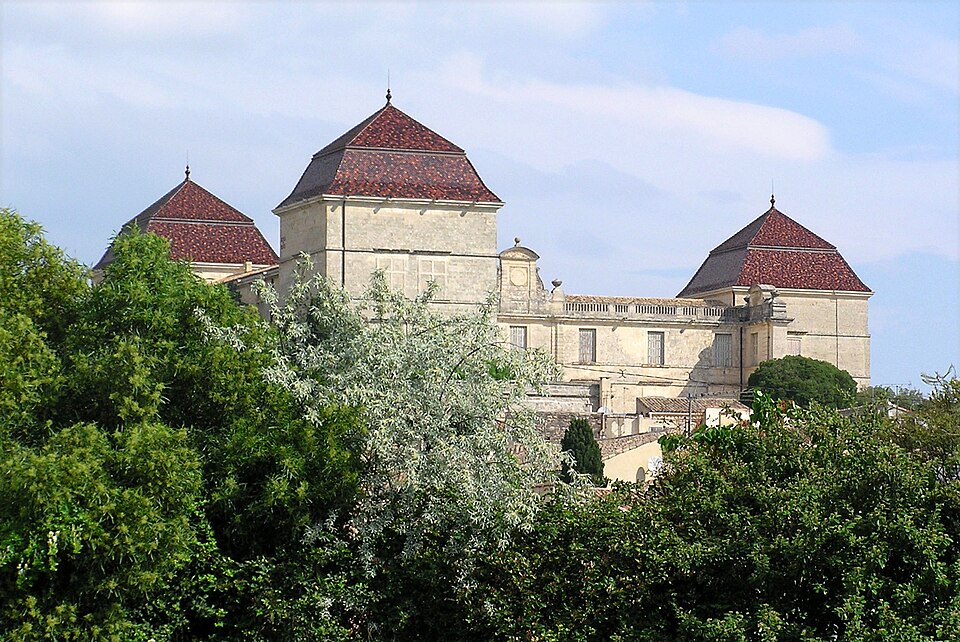
Castries
Château de Castries
Chef protestant, fit raser le château médiéval en 1622
→Duke of Rohan · Prince of Léon
Henri II de Rohan (Blain, 1579 – Königsfelden, 1638), Duke of Rohan and Prince of Léon, was the principal military and political leader of the French Protestants under Louis XIII. Born into the high reformed nobility of Brittany and a petit-cousin of Henri IV, he took the leadership of the Huguenot party after the king's assassination in 1610 and led, from 1621 to 1629, the uprisings known as the « guerres de Rohan ». In Languedoc, he directed the defence of the Protestant strongholds. During the 1622 campaign, he had the medieval castle of Castries razed and its moats filled in, to deprive the royal army of a foothold at the gates of Montpellier, then a Reformed stronghold. Only the rib-vaulted halls on the ground floor of the north wing of the present château survive from this destruction. The siege of Montpellier ended in October 1622 with a peace that was merely a truce; the last war ended in 1629 with the Peace of Alès. Rohan then served France as a diplomat and army commander in Switzerland and the Valtellina, and left notable political and military writings.
Rohan belonged to the « fermes » camp, which refused concessions to the Crown, in opposition to the « prudents » led by Duplessis-Mornay. He relied on the Reformed political assemblies and on the network of Protestant places de sûreté (fortified security towns) inherited from the Edict of Nantes. His brother Benjamin de Soubise defended the La Rochelle region, while he himself held Languedoc and the Cévennes.
Château de CastriesBorn at Blain into a large Protestant Breton family.
After the death of Henri IV, he becomes one of the leaders of the Reformed party.
First Rohan War; he commands the Protestant forces in Languedoc.
He has the medieval castle of Castries razed and its moats filled in to better defend Montpellier.
Peace of Montpellier, negotiated with Lesdiguières on behalf of Louis XIII.
Headquarters established at Anduze; second and third Rohan Wars.
Peace of Alès (Edict of Grace): end of the Wars of Religion in France.
Dies from wounds received at the Battle of Rheinfelden.
As the royal army approached, Rohan had the old fortified castle of Castries, set on a hill some fifteen kilometres from Montpellier, dismantled: walls torn down, moats filled in. The aim was to prevent Louis XIII's troops from establishing an advanced position there. The Catholic lords of Castries rebuilt the château from 1645 onward; two medieval vaulted halls in the north wing are the only surviving witnesses to the destroyed building.
After the Peace of Alès, Rohan drew closer to the Crown and carried out campaigns for Richelieu in Switzerland and the Valtellina. He was also the author of memoirs and treatises, including « De l'intérêt des princes et des États de la chrétienté ».
Cette synthèse croise plusieurs sources pour documenter les lieux, événements et relations historiques.